Six months ago, I was not planning to build an email app.
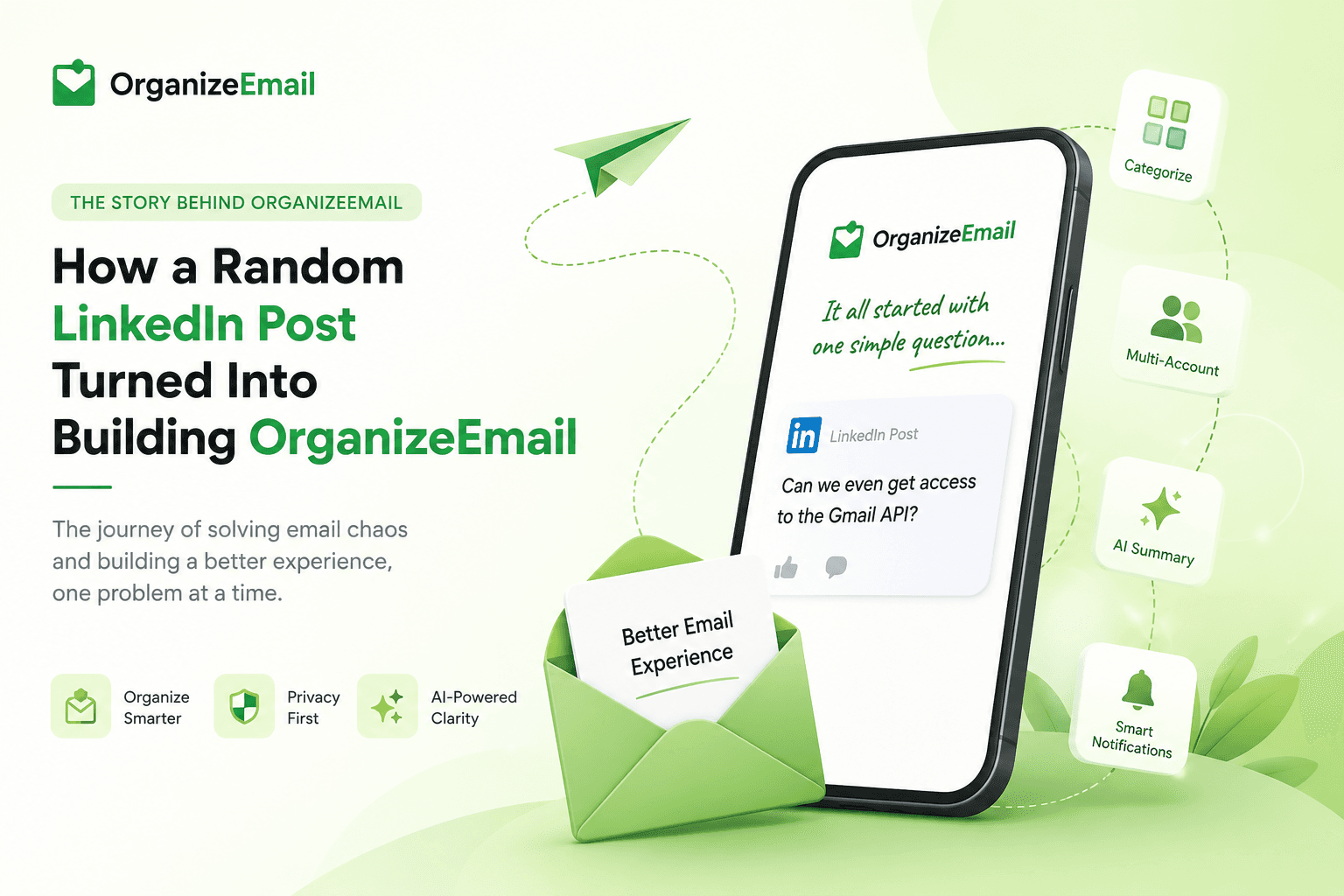
Like most developers, I was scrolling through LinkedIn when a post caught my attention. Someone asked a simple question:
"Can we even get access to the Gmail API?"
It was not a startup pitch. It was not a grand idea. It was just a question.
Out of curiosity, I started reading about the Gmail API. Then I experimented with it. Then I built a small prototype.
At that point, I still had no intention of building a product.
I was simply exploring.
What I did not know then was that one random LinkedIn post would eventually become OrganizeEmail.
Looking at Email with Fresh Eyes
Once I had access to my own inbox through the Gmail API, I started seeing email differently.
Not as individual messages.
But as data.
Patterns started to appear.
- Receipts mixed with newsletters
- Travel bookings buried under promotional emails
- Important conversations disappearing because another message arrived a few minutes later
- Bills hidden somewhere inside hundreds of unread emails
The more I looked, the more I realized something:
Email is not broken because it cannot send or receive messages.
It feels broken because we have accepted a messy experience as "normal."
The Problems I Lived With Every Day
Like many people, I do not use just one email service.
I have Gmail.
I have Outlook.
I have Yahoo.
Every provider has its own app. Its own design. Its own navigation. Its own way of organizing conversations.
If I wanted to check everything, I found myself switching between multiple apps several times a day.
Then there was another frustration: conversation threads.
Threads are powerful when they work.
They are confusing when they do not.
Finding one reply in a long thread often felt harder than it should be. Sometimes I would miss an important email simply because it was buried inside another conversation or hidden beneath dozens of less important messages.
It was not one huge problem.
It was hundreds of tiny frustrations repeated every single day.
Those small annoyances eventually became the motivation behind OrganizeEmail.
The First Version Was Surprisingly Small
The first version of OrganizeEmail was not ambitious.
It did not have AI.
It did not support multiple providers.
There were no smart dashboards. No notification backend. No premium plans. No complex interface.
It simply categorized emails.
That was it.
Looking back, it is almost funny how small it was.
But that tiny prototype answered one important question:
People do not need another inbox.
They need an inbox that understands what they are looking at.
Every Feature Started as a Personal Problem
One interesting thing happened after I started using my own app every day.
Every week, I discovered another problem.
Categorization helped.
But I still wanted faster navigation.
Then I wanted better conversation views.
Then I wanted support for Outlook.
Then Yahoo.
Then workspaces.
Then notifications.
Then AI summaries.
Then smarter organization.
None of these features came from brainstorming sessions.
Almost every one of them came from using the app myself and thinking:
"This could still be better."
OrganizeEmail slowly stopped becoming a categorization app.
It started becoming the email experience I wished already existed.
Building an Email App Is Much Harder Than It Looks
From the outside, an email app seems straightforward.
Connect to Gmail.
Show emails.
Done.
Reality is very different.
There were weeks spent understanding authentication and OAuth.
Time spent navigating Google API requirements and Play Store policies.
Days spent redesigning interfaces that looked good but did not feel intuitive.
Backend work to support real-time notifications.
Performance improvements for inboxes containing thousands of emails.
Supporting multiple providers meant solving the same problem in different ways.
Some features looked simple until implementation began.
Others appeared difficult but turned out to be surprisingly manageable.
And, like every software project, there were bugs that consumed entire evenings for what eventually turned out to be a single missing line of code.
Those moments rarely make it into launch announcements.
But they are a big part of building software.
Learning That Simplicity Takes the Most Work
One lesson kept repeating itself throughout the process:
The simpler I wanted the app to feel, the more complicated it became behind the scenes.
A clean interface is not the result of doing less.
It is the result of solving complexity before the user ever sees it.
Many screens inside OrganizeEmail have gone through multiple redesigns.
Some features were rebuilt from scratch.
Others were removed because they made the experience worse instead of better.
The goal was never to add features just to make the list longer.
The goal was always the same:
Reduce the number of decisions users have to make.
Privacy Was Never an Afterthought
The more I worked with email data, the more I realized something important:
An inbox contains some of the most personal information we have.
- Travel plans
- Financial records
- Medical appointments
- Work conversations
- Family memories
That realization shaped many technical decisions.
Whenever possible, OrganizeEmail processes information on the device instead of treating user data as something to collect.
Convenience should never come at the cost of unnecessary access.
Building trust is far more important than building another feature.
Not Every Week Went as Planned
Not every week ended with a new feature.
Some weeks ended with another redesign.
Another failed experiment.
Another policy requirement.
Another integration issue.
Another unexpected limitation.
Sometimes progress looked like removing code instead of writing it.
Sometimes success meant fixing something users would never even notice.
That is the reality of building software.
The polished version people eventually download is only possible because of hundreds of invisible decisions made long before release.
Why I Keep Building It
People occasionally ask why I continue spending so much time on an email app.
The answer is surprisingly simple:
Because I believe email deserves a better experience.
Email has become one of the most important tools we use every day.
Yet many of us still tolerate cluttered inboxes, confusing conversation views, constant switching between multiple apps, and endless searching for information that should already be easy to find.
We have become so accustomed to these frustrations that they have started feeling normal.
I do not think they should be.
This Is Still Just the Beginning
Six months ago, OrganizeEmail was nothing more than an experiment inspired by a random LinkedIn post.
Today, it has grown into something much bigger than I originally imagined.
And it is still evolving.
The next chapter is not about adding features simply because they are possible.
It is about making email feel less overwhelming.
- Smarter dashboards
- Better organization
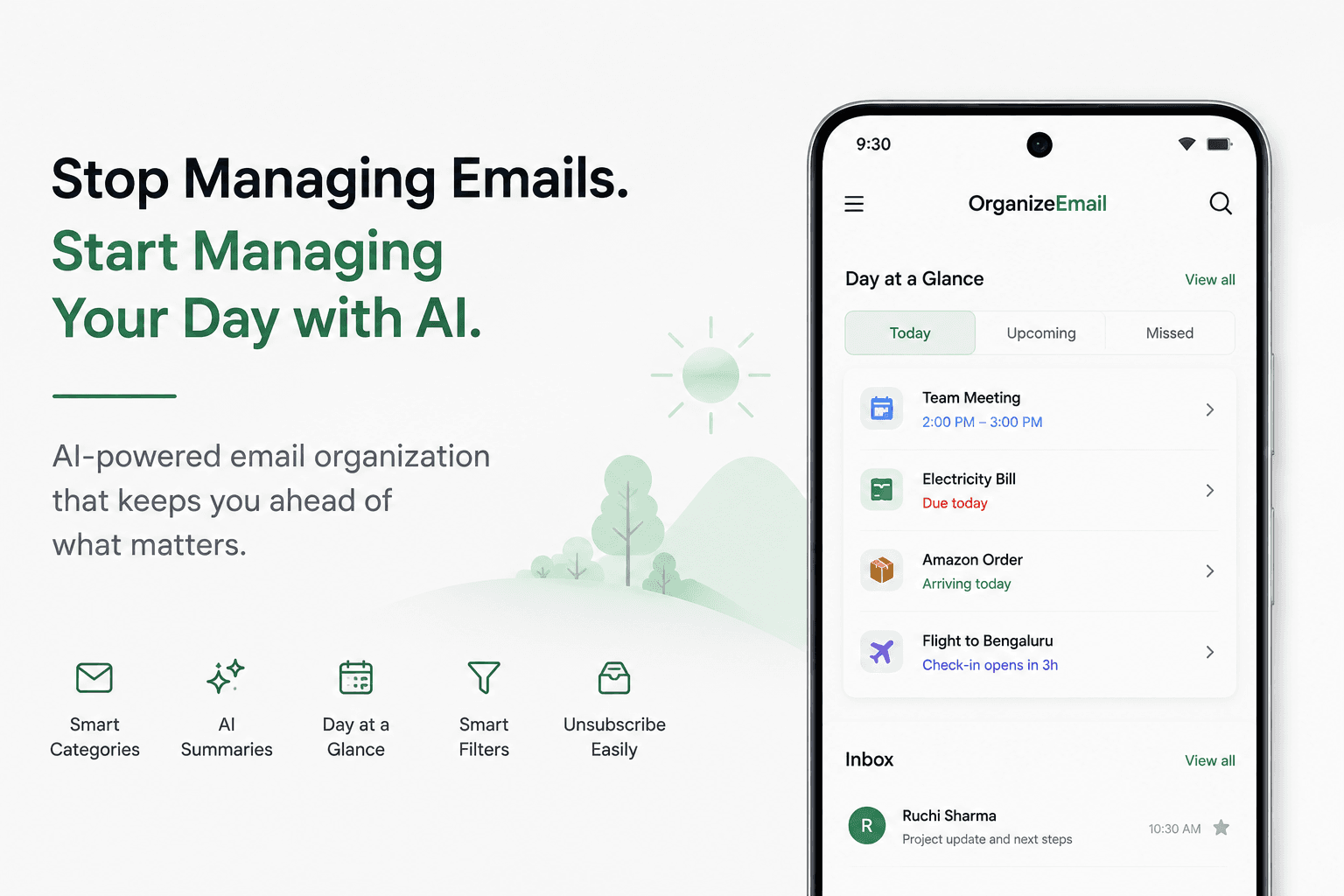
- Helpful AI that reduces effort instead of creating more noise
- An experience that works across providers without making users think about which email app they need to open
There is still a long road ahead.
Many ideas will not work.
Some features will change completely.
Others have not even been imagined yet.
But that is one of the most enjoyable parts of building software.
You never really finish.
You simply keep making it better.
And to think, it all started with a random LinkedIn post asking whether someone could access the Gmail API.
 Product