Artificial intelligence has become one of the biggest shifts in software over the past decade.
Every week, a new AI-powered product promises to help us write faster, code better, organize information, or automate repetitive tasks.
But while everyone is talking about what AI can do, very few are asking an equally important question:
Where is my data going?
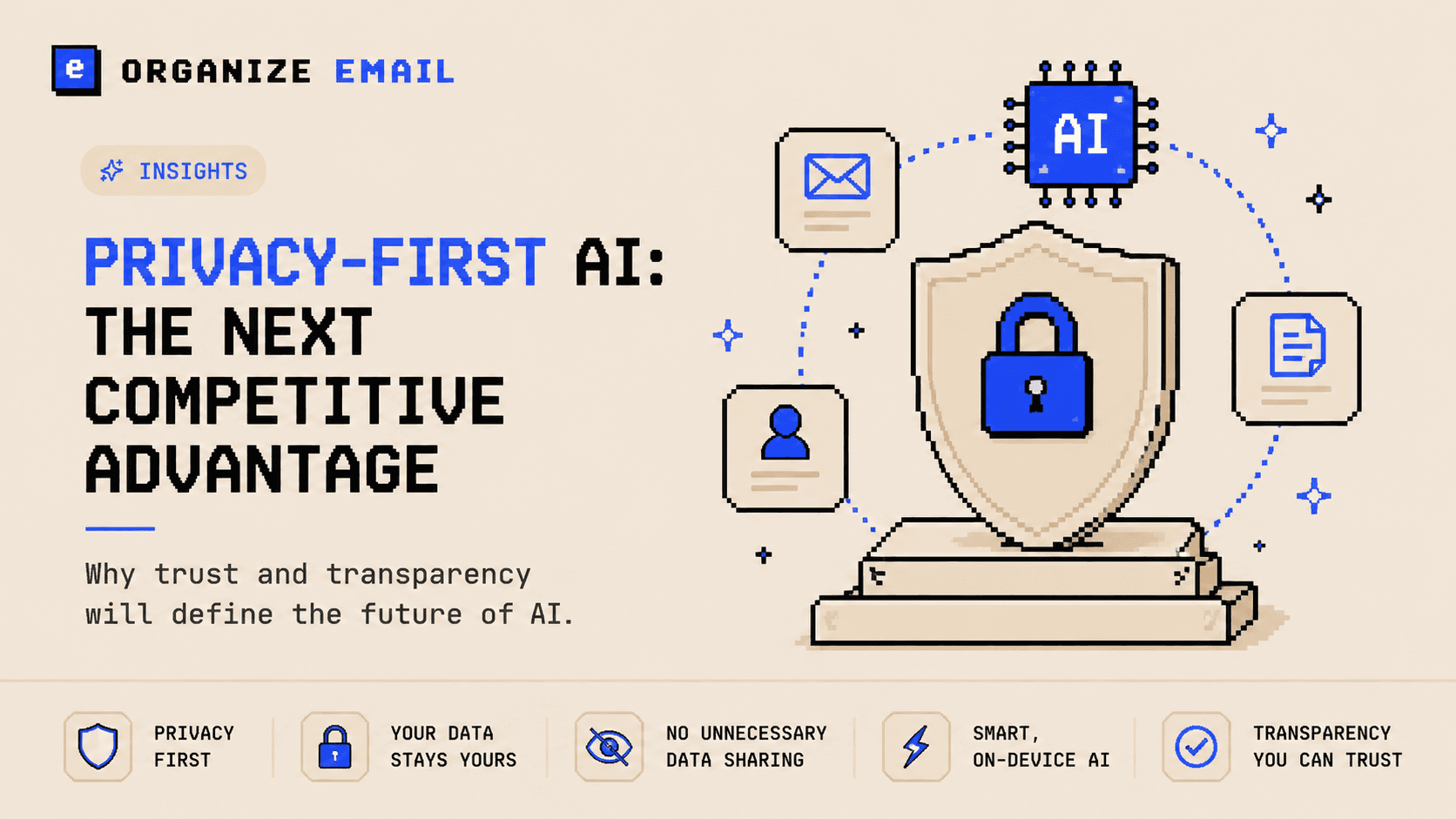
As AI becomes part of our daily workflows, privacy is no longer an optional feature.
It is becoming a deciding factor.
Users Are Sharing More Sensitive Data Than Ever
Think about the information we now feed into AI systems:
- Emails
- Financial documents
- Meeting notes
- Personal journals
- Medical reports
- Business strategies
- Source code
These are not just files.
They are snapshots of our personal and professional lives.
Naturally, people want reassurance that their information is handled responsibly.
Trust Is Becoming a Product Feature
In the early days of software, users chose products based on features.
Today, trust plays an equally important role.
Questions like these matter:
- Is my data stored?
- Is it used for training models?
- Who can access it?
- Can I delete it completely?
- Does processing happen locally or in the cloud?
The answers influence whether people are willing to adopt AI in the first place.
On-Device AI Is Changing Expectations
One of the most exciting developments is the rise of on-device AI.
Instead of sending sensitive information to remote servers, many tasks can now be processed directly on a user's device.
This approach offers several advantages:
- Better privacy
- Lower latency
- Offline functionality
- Greater user confidence
Cloud AI will continue to play an important role, but local AI opens new possibilities for privacy-sensitive applications.
Privacy Does Not Mean Sacrificing Intelligence
There is often a misconception that private AI must be less capable.
That trade-off is becoming smaller every year.
Modern AI systems are increasingly capable of handling summarization, classification, recommendation, and organization while minimizing unnecessary data sharing.
The goal is not simply to build smarter software.
It is to build software people feel comfortable trusting.
The Future Belongs to Responsible AI
The AI race is not only about who builds the smartest model.
It is also about who earns the most trust.
Products that combine intelligence with transparency will stand out in an increasingly crowded market.
Because in the end, users are not just choosing an AI assistant.
They are choosing who they trust with their information.
 Guide
Guide