 Story
StoryJul 4, 2026Vivek Kumar
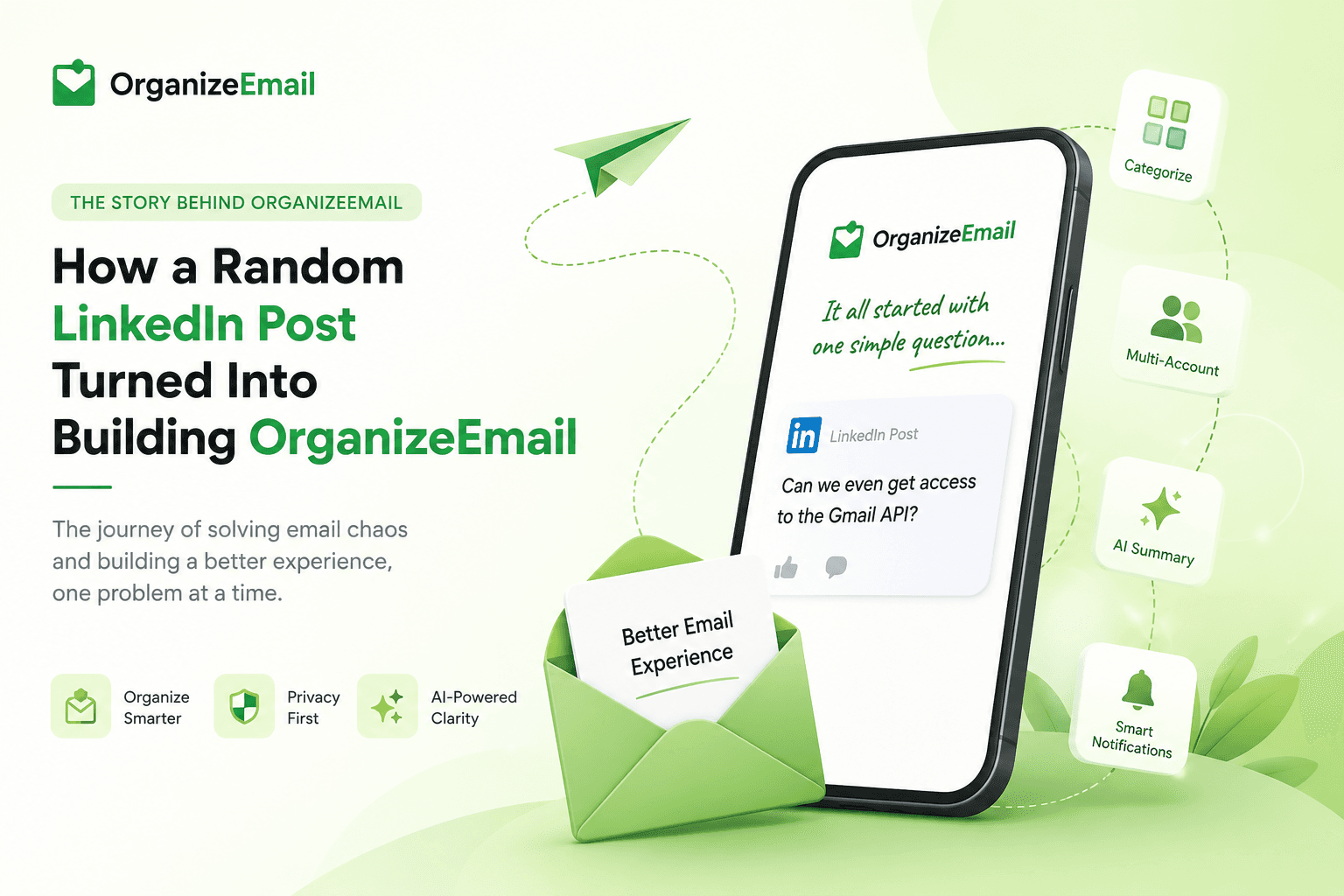
How a Random LinkedIn Post Turned Into Building OrganizeEmail
What started as a simple question about Gmail API access became the foundation for OrganizeEmail, a smarter way to manage email across providers.
A few months ago, I would've said the hardest part of building software was writing code.
Today, I don't think that's true anymore.
With tools like Claude, ChatGPT, Cursor, and GitHub Copilot, writing code has become dramatically faster. Features that once took days can now be prototyped in hours. Entire UI screens appear from a simple prompt, and boilerplate code almost writes itself.
This new way of building has a name now: Vibe Coding.
And honestly?
I love it. It has made me significantly more productive.
But after spending months building OrganizeEmail, one lesson became impossible to ignore:
Code is no longer the bottleneck. Everything around the code is.
One evening, I asked an AI assistant to build a Gmail integration.
Within minutes, it generated:
Everything compiled. Everything looked correct. It felt like the feature was 95% finished.
In reality... I hadn't even started.
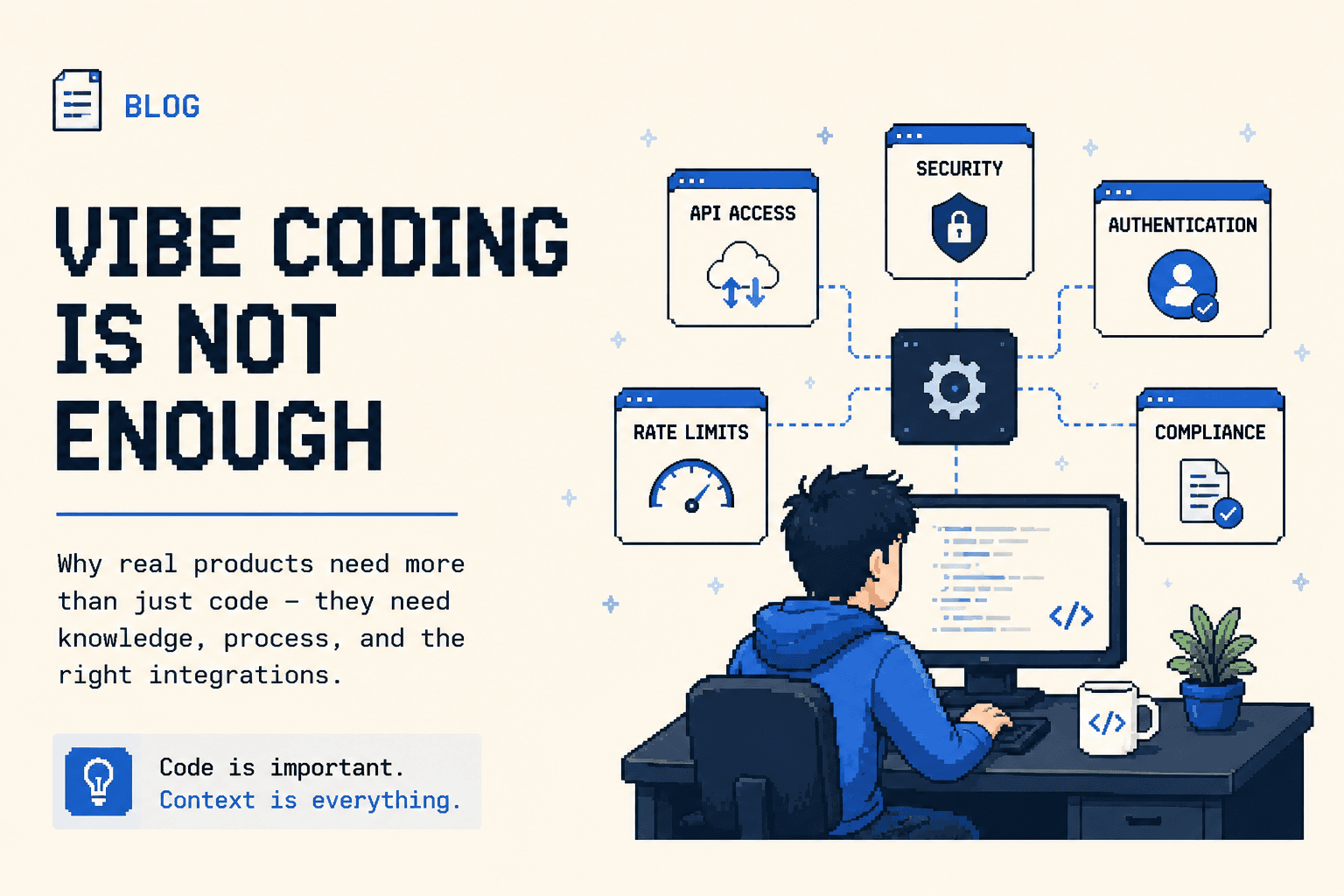
Connecting to Gmail isn't simply calling an API. The moment you want to put that feature in front of real users, you enter Google's complex ecosystem.
That means understanding:
None of this is solved by generating more code.
For OrganizeEmail, we needed access to Gmail so users could organize their inbox intelligently.
Writing the integration wasn't particularly difficult. Getting permission to use it in production was.
We had to understand:
In the grand scheme of things, the code represented only a small part of the journey.
This was something I'd never dealt with before.
If your application requests certain Google data (specifically restricted scopes), you may need a CASA (Cloud Application Security Assessment).
No AI model can magically complete a CASA assessment for you. It requires you to fully understand and document:
These are product-level and organizational responsibilities, not coding problems.
After Gmail, adding Outlook sounded simple. "Just connect another provider," I thought.
Except it wasn't.
Microsoft Graph operates under a completely different paradigm:
While the UI on the frontend barely changed, the underlying product knowledge required to make it production-ready changed completely.
Building OrganizeEmail wasn't just about writing Android or web code. It also meant learning and addressing things that AI prompt boxes don't prepare you for:
None of these problems disappear because AI writes code faster. If anything, they become more prominent.
The same lesson applied when we built Sayne.
Creating a beautiful website wasn't the difficult part. The difficult part was designing an experience that actually communicates trust and authority.
Questions we had to answer included:
Those decisions weren't programming tasks. They were product decisions.
I think many developers misunderstand what AI is changing.
AI isn't replacing engineers. It is replacing repetitive implementation. That is a huge difference.
Instead of spending six hours writing boilerplate, we now spend six hours understanding the actual system and problem we're trying to solve. Ironically, this makes domain and product knowledge more valuable than ever.
A few years ago, strong engineers were measured by how quickly and cleanly they could write code.
Today, the best engineers are measured by how quickly they can understand systems:
These skills don't become less important because AI exists. They become your core competitive advantage.
Before starting OrganizeEmail, I thought software development was mostly about engineering.
Now, I think it's closer to building a business. You are constantly learning about:
Writing code is just one piece of that puzzle. And thanks to AI, it may no longer be the biggest piece.
I still use AI every single day. I use it to write code, review architecture, generate ideas, and speed up development. I wouldn't want to build without it.
But I've stopped believing that faster coding automatically translates to faster products.
Because the real challenge isn't making software compile. It's making software trustworthy, secure, compliant, scalable, and genuinely useful.
Vibe coding can get your prototype running. Understanding the ecosystem is what gets your product into users' hands.
Explore more OrganizeEmail articles.
StoryWhat started as a simple question about Gmail API access became the foundation for OrganizeEmail, a smarter way to manage email across providers.
 Opinion
As AI becomes part of everyday software, privacy is turning from a nice-to-have into a real product differentiator. The next generation of AI products will compete on trust as much as intelligence.
 Opinion
Inbox Zero no longer reflects how modern email works. AI-driven prioritization, summaries, and privacy-first assistance will define the future of email management.
Join our newsletter to get the latest tips on productivity and inbox mastery.